Friday, 10 October 2008

Five projects to come up along Del-Mum corridor

With the Delhi-Mumbai Industrial Corridor on the verge of implementation, Haryana has identified a few early-bird projects to be developed along the corridor passing through the state.

The Haryana State Industrial and Infrastructure Development Corporation (HSIIDC), being the nodal agency in Haryana for this project, has proposed five projects, which will further give a boost to industrial activity of the state. The Delhi-Mumbai Industrial Corridor (DMIC) is being established by the Government of India with Japanese collaboration.

A senior official of HSIIDC informed FE, "Since the corridor covers a major portion of Haryana, we have proposed few early-bird projects to be developed under the public-private partnership (PPP) mode. A delegation of officials from the state will be visiting Tokyo from 16th to 18th October to discuss these proposals in detail, there."

The projects include a Regional Mass Rapid Transport Service (MRTS) between Delhi-Manesar-Bawal, with feeder service to enhance connectivity between Delhi and the upcoming manufacturing hubs, a joint venture project around Dharuhera and a logistic hub at IMT Manesar. Two rail projects have also been proposed including rail links from Faridabad to Gurgaon and Jhajjar to Farrukhnagar.

"The rail links will facilitate the movement of people along the corridor as there are two growth centers at Bawal and Palwal, which will be the hub of industrial development. DMIC work has been segmented into three parts namely Delhi-Rewari, Rewari-Vadodra and Vadodra to Mumbai. Work has already begun on the Rewari-Vadodra stretch," the official further added.

Clocking about 70% of the total Japanese investment in India , Haryana is still on the radar of many Japanese companies. As per estimates of the HSIIDC, Japanese companies have so far invested close to Rs 11,000 crore in the state via joint ventures or as direct investment.

With about 65 companies in Haryana, including names like Maruti, Honda Motor Company, YKK Corporation etc, already having Japanese collaboration, more investment is expected in the future. Another proposal has been put forth by Japanese giant- Mitsui and Company to set up an industrial park in Haryana over 3,000 acres of land at an estimated investment of around Rs 1,200 crore. The company plans to develop this project along the upcoming Kundli-Manesar-Palwal Express.

The Rajasthan State Industrial Development & Industrial Corporation (RIICO) has also signed an MoU with the Japanese External Trade Organization (JETRO) for Japanese investments in Neemrana and has reserved an industrial part for Japanese investments mostly for small and medium auto component sector.

Thursday, 9 October 2008

PARIS 2008: FASTEST JAGUAR SINCE XJ220


Jaguar released the hottest XK till date when it revelaed the XKR-S at the Paris Motor Show yesterday. The power(a lot of it) comes from a 4.2 Litre V8 engine with 420 bhp on tap. It is sent to the rear wheels via a six speed automatic gearbox  with Jaguar’s sequential shift transmission, enough to propel the XKR-S from o-60 mph in 5.2 seconds and to a top speed of 174 mph.

With those numbers to boot, the XKR-S is the fastest Jag model since the XJ220 supercar. Along with the increased power the car comes with a host of mechanical refinements to rein it all in. The suspension has been revised with new springs and dampers rates, larger anti-roll bars at the rear and a recaliberated version of Jag’s CATS  (Computer Active Technology Suspension). New aerodyanamic enhancements keep the new Jag planted at speeds while active exhaust and saturn rings sized brakes (400mm front and 350mm rear Alcon R performance brakes) complete the overhaul nicely.

The Jaguar XKR-S production is limited to just 200 cars for both left and right hand drive versions and will be available only in Europe.

Nintendo takes on Sony with console upgrade

Nintendo is to launch a new version of its popular DS handheld game console in Japan next month.

The DSi will have a built-in camera and a music player. It will have a bigger screen than the current DS Lite but is fully compatible with the existing machine.

Nintendo’s move is aimed at pegging back the recent success of Sony, its rival, in the lucrative computer games industry.

Nintendo has had huge success with its handheld DS, as well as its Wii console, but Sony has recently enjoyed strong sales in Japan with its rival PlayStation Portable handheld gaming device, on the back of its popular Monster Hunter game.

“From the summer of last year, Japanese DS sales started to slow down,” said Satoru Iwata, president of Nintendo. The new model is aimed at reinvigorating domestic sales and will not be available to US and European consumers ahead of the end-of-year sales in the run-up to Christmas.

While there is a danger that some customers in the US and Europe may defer a purchase until they can get the new model, Nintendo has bundled the existing DS with software in those markets, amounting to a de facto price cut.

Reaction to the DSi on Thursday was lukewarm, however. “This should mean that Nintendo can sustain DS sales of 30m for the next year or two, but in our view it doesn’t drive DS consumption to massive new annual levels,” said David Gibson, an analyst at Macquarie Securities in Tokyo.

Comments on popular gaming blogs were less generous. “Yawn. I know the DS is huge, but this really doesn’t seem to add anything to it,” said one poster on Kotaku. “Whether I buy it will depend on the downloadable contents,” said SiZ on Engadget Japan.

The DS was launched four years ago, and with about one sold for every five people in Japan, it has almost reached saturation.

Nintendo’s strategy is to target casual gamers and it points out that 54 per cent of Japanese DS users are female.

The inclusion of a camera and music player brings handheld consoles into competition with mobile phones for the first time, but the DSi is carefully designed to avoid direct rivalry. Its camera only has a 0.3 megapixel resolution – far less than the latest mobile phones – and it will lack the storage capacity of a music device such as Apple’s iPod.

The DSi is instead designed for fun. Applications Nintendo showed included sticking a moustache on your photo, distorting the pitch of music, and software that tells you whether two people in a photo are related.

IBM lifted by $2.8bn profit

IBM on Wednesday moved to shore up its sliding share price by announcing better-than-expected third-quarter profits and reaffirming its forecast for the full year.

The surprise move, which came a week before the company’s scheduled earnings release, sent shares in the world’s second-biggest IT company up 3.8 per cent in after-hours trading.


IBM had closed at a two-year low of $90.55, down 5 per cent on the day.

Shares in the company had fallen 5 per cent on Tuesday after a Barclays Capital analyst lowered his estimates due to the weakening economy and IBM’s “large exposure to financial services”.

IBM on Wednesday said that it had made a net profit of $2.8bn, or $2.05 per share, in the third quarter, up 20 per cent from a year earlier and better than many Wall Street analysts had expected.

Sales were $25.3bn, an improvement of 5 per cent over last time, although part of that improvement was due to currency movements.

IBM said it expected full-year earnings of $8.75 per share, in line with previous estimates.

“We remain confident in our full-year outlook,” Samuel Palmisano, chief executive, said.

MERCEDES BENZ POSTS RECORD NUMBER FOR 2008

It seems the global auto slowdown hasnt really hit the Indian market, atleast not the luxury car market. Mercedes-Benz India has posted record sales for the first three quarters of the year 2008 with total sales already above 3000 cars! The cumulative sales as a result have grown by a whopping 56% for January to September period when compared to the same period last year.

“Our impressive performance this year continues – we are delighted to cross the 3000 sales figure mark for the first time and have already set our sights on many more. This impressive performance in an otherwise fluctuating economy is commendable. Mercedes-Benz has proved again that it is the luxury car of choice for the Indian customer. We are confident that in the coming months and years. We will continue to grow and remain competitive in an already ultra dynamic market” commented Dr. Wilfried Aulbur, Managing Director and CEO of Mercedes-Benz India.

The company has posted an increase in sales for all of its models sold in India. The new C-Class which made its debut at the auto expo this year is the biggest gainer with 1450 units sold betweeen January to September, year on year growth of more than 135%! The S-Class continues to be the favourite among the riches with more than 524 units sold by the end of the third quarter, a growth of 64% year on year. The evergreen E-Class also continues to sell well with 921 cars moving out of the showroom b/w January to September. Mercedes-Benz also intoduced two new engine options for the E-Class this year christened the E230 and E220 CDI which makes it the most comprehensive product with largest number of variants in its class.

ALFA ROMEO 8C COMPETIZIONE GOES ON SALE IN US, SOLD OUT ALREADY!


Alfa Romeo is back in US, well partially. After exiting the US market in 1995 due to slumping sales and discontent customers, the brand is making a come back by launching the Alfa 8C Competizione, the $200,000 high performance coupe that has captured the fancy of automobile lovers across Europe.

The Alfa 8C Competizione is now officially available across USA through designated Maserati dealers selected to sell the car. But it doesnt matter as of now beacuse all the 8C’s earmarked for the US market for the year have already been spoken for. The spyder version will come in later, by 2010. After the full operations are started in the USA, the whole Alfa range will be available throughout the dealerships, from Brera coupe to the 159 sedan or their replacements MiTo and the 149. The company is also looking at a large rear wheel drive car which will be based on a Jaguar platform.

CII WELCOMES GUJRAT GOVERNMENTS POLICY ON TATA NANO

CII has welcomed Gujrat Government’s policy on getting the Tata Nano plant in the state.

“Gujarat is one of the most investor friendly states with an impeccable record of industrial relations. CII is working closely with the Government of Gujarat to promote further industralisation of the state through the “Vibrant Gujarat” initiative, by highlighting the superior infrastructure, industrial climate and efficient governance in the state. CII is therefore, delighted that “Nano” has found a home in such a state.” said Chandrajit Banerjee, Director General, CII

Monday, 6 October 2008

PARIS 2008: SUZUKI ALTO (A-STAR) UNVEILED


Suzuki Motor Company has unveiled the Alto (A-Star) at the ongoing Paris Motor Show. Designed with considerable input from Suzuki’s Indian R&D center, the Alto (A-Star) will be built exclusively in India for the world market as well for domestic consumption. The car will be launched in India by the end of October.

The new Alto (A-Star) stands 3550mm long, 1600mm wide, 1470mm high with a wheelbase of 2360mm. The cheeky overall styling and the cute front is expected to go down well with the buyers here in India and outside.

The Alto (A-Star) will also debut the ‘K’ series engines from Suzuki which is considered a master of smaller internal combustion engines. The 1000cc engine in the Alto (A-Star) develops a very healthy 68 ps @ 6000 rpm and a maximum 90 nm of torque @ 4800 rpm. The engine is highly fuel efficient too with a combined fuel consumption figure of 22 kmpl and is Euro 5 compliant already. A co-efficient of drag of just .30 also helps the top speed which is a decent 155 kmph and the overall efficiency.

The top 12 world's greatest aviation innovations revealed

Washington, Oct 5 (ANI): Hundred years since the Wright Brothers took wing many inventions have taken place in the field of aviation. Now, a website has compiled a list of the greatest innovations that have taken the world by storm.

The list of top 12 inventions has been amassed by aviation.com, reports Wired News.

1. Cabin pressurization: The average passenger doesn't think about cabin pressurization until their yellow safety masks fall from the ceiling, but the reality is that if the technology hadn't been developed during WWII, people wouldn't be able to fly much above 10,000 feet.

2. Black Box: Morbid but essential, the black box was invented in the mid-1950s, and not only helps investigators learn why a plane crashed, but how that information can be applied to other aircraft to prevent a repeat.

3. The Concorde: It never delivered on its commercial promise, and it was an environmental bad boy, but who can deny that breaking the sound barrier aboard a commercial aircraft is cool.

4. Radar: Sure, the airlines are dying to replace it with GPS technology, but for decades it's been radar that helps air traffic controllers locate and track planes up to 200 miles away.

5. The jumbo jet

6. The hub and spoke system

7.The Very Light Jet (VLJ)

8. Winglets

9. The flying wing

10. Stealth aircraft

11. Jetway

12. Deicing (ANI)

Policies and Procedures

In this experiment they put eight monkeys in a room. In the middle of the room is a ladder, leading to a bunch of bananas hanging from a hook on the ceiling.


Each time a monkey tries to climb the ladder, all the monkeys are sprayed with ice water, which makes them miserable.


Soon enough, whenever a monkey attempts to climb the ladder, all of the other monkeys, not wanting to be sprayed, set upon him and beat him up.


Soon, none of the eight monkeys ever attempts to climb the ladder.


One of the original monkeys is then removed, and a new monkey is put in the room. Seeing the bananas and the ladder, he wonders why none of the other monkeys are doing the obvious, but, undaunted, he immediately begins to climb the ladder.


All the other monkeys fall upon him and beat him silly. He has no idea why. However, he no longer attempts to climb the ladder.


A second original monkey is removed and replaced.


The newcomer again attempts to climb the ladder, but all the other monkeys hammer the crap out of him.


This includes the previous new monkey, who, grateful that he's not on the receiving end this time, participates in the beating because all the other monkeys are doing it.


However, he has no idea why he's attacking the new monkey.


One by one, all the original monkeys are replaced, eight new monkeys are now in the room. None of them have ever been sprayed by ice water. None of them attempt to climb the ladder.


All of them will enthusiastically beat up any new monkey who tries, without having any idea why.


mother's sacrifice

if u have time take a look at this story.

My mom only had one eye. I hated her... she was such an embarrassment. My mom ran a small shop at a flea market. She collected little weeds and such to sell... anything for the money we needed she was such an embarrassment. There was this one day during elementary school.


I remember that it was field day, and my mom came. I was so embarrassed.


How could she do this to me? I threw her a hateful look and ran out. The next day at school..."Your mom only has one eye?!" and they taunted me.


I wished that my mom would just disappear from this world so I said to my mom, "Mom, why don't you have the other eye?! You're only going to make me a laughingstock. Why don't you just die?" My mom did not respond. I guess I felt a little bad, but at the same time, it felt good to think that I had said what I'd wanted to say all this time.
 

Maybe it was because my mom hadn't punished me, but I didn't think that I had hurt her feelings very badly.
 

That night...I woke up, and went to the kitchen to get a glass of water. My mom was crying there, so quietly, as if she was afraid that she might wake me. I took a look at her, and then turned away.


Because of the thing I had said to her earlier, there was something pinching at me in the corner of my heart. Even so, I hated my mother who was crying out of her one eye. So I told myself that I would grow up and become successful, because I hated my one-eyed mom and our desperate poverty.
 

Then I studied really hard. I left my mother and came to Seoul and studied, and got accepted in the Seoul University with all the confidence I had. Then, I got married. I bought a house of my own. Then I had kids, too. Now I'm living happily as a successful man. I like it here because it's a place that doesn't remind me of my mom.
 

This happiness was getting bigger and bigger, when someone unexpected came to see me "What?! Who's this?!" ...It was my mother...Still with her one eye. It felt as if the whole sky was falling apart on me. My little girl ran away, scared of my mom's eye.
 

And I asked her, "Who are you? I don't know you!!!" as if I tried to make that real. I screamed at her "How dare you come to my house and scare my daughter! GET OUT OF HERE! NOW!!!" And to this, my mother quietly answered, "oh, I'm so sorry. I may have gotten the wrong address," and she disappeared. Thank good ness... she doesn't recognize me. I was quite relieved. I told myself that I wasn't going to care, or think about this for the rest of my life.
 

Then a wave of relief came upon me...one day, a letter regarding a school reunion came to my house. I lied to my wife saying that I was going on a business trip. After the reunion, I went down to the old shack, that I used to call a house...just out of curiosity there, I found my mother fallen on the cold ground. But I did not shed a single tear. She had a piece of paper in her hand.... it was a letter to me.
 

She wrote:

My son...


I think my life has been long enough now. And... I won't visit Seoul anymore... but would it be too much to ask if I wanted you to come visit me once in a while? I miss you so much. And I was so glad when I heard you were coming for the reunion. But I decided not to go to the school.... For you... I'm sorry that I only have one eye, and I was an embarrassment for you.
 

You see, when you were very little, you got into an accident, and lost your eye. As a mother, I couldn't stand watching you having to grow up with only one eye... so I gave you mine...I was so proud of my son that was seeing a whole new world for me, in my place, with that eye. I was never upset at you for anything you did. The couple times that you were angry with me.


I thought to myself, 'it's because he loves me.' I miss the times when you were still young around me.
 

I miss you so much. I love you. You mean the world to me.


My world shattered!!!

 
Then I cried for the person who lived for me... My Mother

SRK's Red Chillies to pump Rs 100 cr for three films in 2008

KOLKATA: After superhit Om Shanti Om and soon-to-be-released Billo Barber, Shah Rukh
Shah Rukh Khan
Khan’s Red Chillies Entertainment is going to invest Rs 100 crore to reel out three more movies this year. This includes a Rs 60-crore flick with computer-generated special effects starring the King Khan himself and two medium-budget films, each with a budget of Rs 20-25 crore. 

Talking to ET on the sidelines of a Nokia event here on Saturday, Mr Khan said the title of the big-budget special-effects film has been tentatively decided as Ra.one. “We will finalise the script, cast and director for the two medium-budget films by this month,” he said. 

Red Chillies also plans to set up a film studioin India on the lines of the Hollywood studios. “This will be one-of-its-kind project in Bollywood. We will require huge space for this. We are yet to finalise the location, but it will not be viable to build this project in Mumbai,” Mr Khan added. 
Shah Rukh has decided to make a major foray into television show productions through a separate entity under Red Chillies, called ‘Idiot Box’. “We will focus on production of lifestyle shows and will provide a cinematic experience to TV shows. We are currently finalising the shows which will soon start production,” Mr Khan said. 

Elaborating on the revenue model, Mr Khan said he intends to retain the distribution rights of all the movies produced by him. “We have retained the distribution rights of Billo Barber. The cash flow from these movies will be ploughed back into the forthcoming movies,” he said. 

Apart from movie and TV production, Red Chillies also has presence in TV commercial production, leasing of movie production equipment and visual effects. “We have already done special effects for Om Shanti Om, Chak De and Drona. We plan to double the present headcount of 140 employees in this venture by this year,” Mr Khan said. 

Mr Khan said he is also open to the idea of roping in a big industrial house for co-productions in the future. “We might even look at vernacular movies. Red Chillies has a huge in-house talent pool from across India which might be utilised for such movies. But nothing is finalised as of now,” he added. 

Talking about his IPL team Kolkata Knight Riders, Mr Khan said the franchisee has made a profit of about Rs 5 crore in the first year. “We would like to quadruple it in the forthcoming season. However, there are no plans to dilute equity in any of the ventures,” added King Khan.

Chennai and Hyderabad amongst top global IT hubs


While the focus of the study was to identify the top 50 emerging cities, it also listed the top global outsourcing cities. 

The Top 8 Global Outsourcing Cities includes a few new members — Chennai (India), Hyderabad (India), Makati City (The Philippines) and Pune (India). 

As expected, Indian cities dominate the list once again. Makati City, as part of the Philippines NCR (National Capital Region) holds its ground.

Cebu, Shanghai & Beijing tops list of global outsourcing cities


Cebu City (The Philippines), Shanghai (China) and Beijing (China) lead the list of emerging global outsourcing cities. 

The ‘Top 50 Emerging Global Outsourcing Cities’ 2008 list has nine entrants - Quezon City, Toronto, Rio de Janeiro, Mexico City, Jaipur, Singapore City, Chengdu, Guadalajara and Mandaluyong City.

Six Indian cities among top 8 global outsourcing cities


The Top 8 Global Outsourcing Cities includes as many as six Indian cities led by Bangalore, Chennai, Delhi National Capital Region, Hyderabad, Mumbai and Pune.

Dublin (Ireland) and Makati City (The Philippines) are the other two cities in the list, according to a study by CyberMedia’s Global Services and investment advisory firm Tholons. 

India’s representation in the top 50 Emerging Global Outsourcing cities has grown to four, from last year’s three, with the addition of Jaipur to the list at No 31. 

The other three cities in the list include Kolkata at No 6, Chandigarh at No 12 and Coimbatore at No 17.


Scientists develop solar cells with a twist

CHICAGO: US researchers have found a way to make efficient silicon-based solar cells that are flexible enough to be rolled around a pencil and tra

nsparent enough to be used to tint windows on buildings or cars. 

The finding, reported on Sunday in the journal Nature Materials, offers a new way to process conventional silicon by slicing the brittle wafers into ultrathin bits and carefully transferring them onto a flexible surface. 

"We can make it thin enough that we can put it on plastic to make a rollable system. You can make it gray in the form of a film that could be added to architectural glass," said John Rogers of the University of Illinois at Urbana-Champaign, who led the research. 

"It opens up spaces on the fronts of buildings as opportunities for solar energy," Rogers said in a telephone interview. 

Solar cells, which convert solar energy into electricity, are in high demand because of higher oil prices and concerns over climate change. Many companies, including Japanese consumer electronics maker Sharp Corp and Germany's Q-Cells are making thin-film solar cells, but they typically are less efficient at converting solar energy into electricity than conventional cells. Rogers said his technology uses conventional single crystal silicon. 

"It's robust. It's highly efficient. But in its current form, it's rigid and fragile," he said. Rogers' team uses a special etching method that slices chips off the surface of a bulk silicon wafer. The sliced chips are 10 to 100 times thinner than the wafer, and the size can be adapted to the application. Once sliced, a device picks up the bits of silicon chips "like a rubber stamp" and transfers them to a new surface material, Rogers said. 

"These silicon solar cells become like a solid ink pad for that rubber stamp. The surface of the wafers after we've done this slicing become almost like an inking pad," he said. 

"We just print them down onto a target surface." The final step is to electrically connect these cells to get power out of them, he said. Adding flexibility to the material would make the cells far easier to transport. Rogers envisions the material being "rolled up like a carpet and thrown on the truck." He said the technology has been licensed to a startup company called Semprius Inc in Durham, North Carolina, which is in talks to license the technology. 

Analysts' pick: Reliance Petroleum

Target price: Rs 115 
Brics Securities has downgraded its rating on the stock from neutral to ‘underperform’ saying it sees no margin of safety at the current price. 


“We are lowering our FY09-12(estimated) EPS estimates for RPL after factoring in lower GRM (gross refining margins) and a weaker rupee. Our forecast for lower GRMs is based on the deteriorating outlook for the global oil refining industry,” said the broking house in a note to its clients. 

The outfit has revised its GRM estimates downwards on the back of worsening fundamentals for the oil refining industry due to large capacity additions, weakening demand growth and increasing complexity of new refineries. 

“These factors will result in lower capacity utilisation for refineries and reduce the advantage enjoyed by complex refiners. FY09E earnings are also negatively affected by lowering of our throughput estimates by 19.5% to 7.6 mmt (million metric tonne) due to a later start-up than our expectation,” the note added.

Nifty breaches 3600; Sensex down 700 points

MUMBAI: Traders were helplessly gawking at their trading terminals on the Dalal Street as equities plunged sharply after funds took exit route from Indian market. Secondline stocks were the worst hit under performing the benchmarks. 

At 3:30 pm, Bombay Stock Exchange’s Sensex was down 711.20 points or 5.68 per cent at an intra-day low of 11,815.12. 

National Stock Exchange’s Nifty breached crucial technical support of 3,600 but managed to crawl back at 3,607, down 210.75 points or 5.52 per cent. The index touched a low of 3,597 in trade so far. 

BSE Midcap Index was down 6.76 per cent at 4361.48 and BSE Smallcap Index plunged 6.34 per cent to 5,118.91. 

Sterlite Industries (14.45%), Tata Steel (12.42%), Jaiprakash Associates (11.41%), Reliance Infrastructure (11.16%), Reliance Communications (10.71%) and DLF (10.7%) were the worst hit. 

None of the stocks from the 30-share index managed to brave the tide. 

Market breadth weakened further with 2341 declines against 255 advances on BSE.

Sunday, 5 October 2008

Curfew clamped after communal clashes in Maharashtra's Dhule town

Nashik (Maharashtra), Oct 5 (ANI): Following clashes between members of two communities in Dhule town in North Maharashtra today, curfew was clamped in the town, said police.

The district authorities took measure after the situation had gone out of control with rioters indulging in arson and stone pelting.

The police had to use tear gas shells and fired in air to disburse unruly mob.

Trouble started this afternoon when some people, belonging to a particular community, allegedly tore-off banners of a Hindu outfit appealing people to attend a public meeting in Dhule's Ram Mandir Chowk in the evening.

There were reports of heavy stone-pelting from Bhangar Bazar Chowk, where mob set ablaze some vehicles and looted a shop.

Police said that the mob made an unsuccessful attempt to set ablaze a place of worship. (ANI)

Strong earthquake hits Central Asia

A strong earthquake hit Central Asia on Sunday but there were no immediate reports of destruction or casualties, the U.S. Geological Survey and the Kyrgyz emergencies ministry said.

The U.S. Geological Survey reported that a 6.3-magnitude earthquake struck 35 miles (55 km) east of Sary-Tash near the borders of Tajikistan and Uzbekistan at 9:52 p.m. (1552 GMT). It had a depth of 21.7 miles (35 km), the survey reported.

The Kyrgyz emergencies ministry said it had information that a quake measuring 8.5 on a 12-level scale assessing earthquake intensity jolted the densely populated southern region of Osh.

"There are no reports of casualties or destruction. We are checking all information," Ramis Satybekov, an emergencies ministry official, told Reuters by telephone from Osh.

An earthquake of magnitude 6 and over is capable of causing severe damage. The earthquake was also felt in the capitals of Tajikistan and Uzbekistan.

Alla Pyatibratova, a Kyrgyz journalist working in Osh, said there was no visible destruction in Kyrgyzstan's second-biggest city.

"Everyone felt the earthquake and immediately ran outside. I did not see anything destroyed. People returned to their homes after a while," she said from Osh.

The U.S. agency initially reported the magnitude as 6.9, but revised it downward. There was an aftershock of magnitude 5.7, USGS said.

The border area between Kyrgyzstan, Tajikistan and Uzbekistan lies in a seismically active part of Central Asia and earthquakes are frequent in this most densely populated part of the former Soviet region.

In 1966, the Uzbek capital Tashkent was flattened by a 7.5 earthquake when hundreds of thousands of people were left homeless. A 6.0 magnitude quake on the 12-level rocked Tashkent this August but there was no damage.

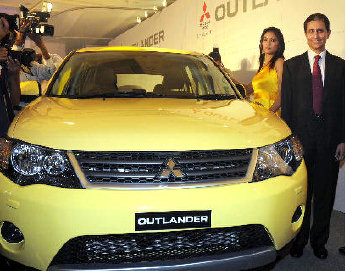
HM Launches SUV Outlander

Leading automobile manufacturer, Hindustan Motors launched a new HM Launches SUV Outlandersports utility vehicle ‘Outlander’ on Friday. It would also launch some other vehicles in the coming months.

Outlander is an ‘all wheel control’ (AWC) sports utility vehicle that supports 16 valve MIVEC (Mitsubishi Innovative Valve Timing and Electronic Control system) petrol engine. It supports advanced control systems, safety and luxury features. 

The price of the vehicle is fixed at Rs. 20.20 lakh. The company is assembling it in its Tiruvallur (Chennai) car plant. Japanese auto major, Mitsubishi would provide assistance in its marketing and manufacturing as per their agreement.

The managing director of Hindustan Motors, R. Santhanam said that the new SUV is aimed to attract the passionate people who want to enjoy new sports experience. The SUV is designed with the MIVEC technology of Mitsubishi. It would make it very eco friendly, fuel efficient and best performer. The company has set a target to sell at least 100 units of the SUV every month.

The chairman of HM, Mr. C. K. Birla said that the market conditions would become favorable for sale before the festival season. The prices of raw materials are coming down and company is expected to improve the margins.

Subir Gokarn:Messages from Singur

The state governments should design strategies so as to make them inclusive, says subir gokarn.

Tata Motors’ formal announcement of their decision to move the Nano project out of Singur brings to an end a rather complex story. It is complex because it is not at all clear who won and who lost, and whether the gains outweighed the losses. The collective stakeholders in Tata Motors obviously lost at one level, because, apart from the unrecoverable costs that they had already incurred, their strategy has been derailed. But, who knows? Locating the Nano project in a more conducive environment may ultimately prove to be its saviour.

The state of West Bengal may also have lost out in its ambitious plan to re-invent itself as a place to do business in. In the process, the government’s attempts to accommodate the changing aspirations of the state’s younger generations may have been permanently de-railed. But then, perhaps this episode shows us that the whole strategy was inadequately designed. It did not take into consideration the totality of stakeholder interests and, if not in Singur or Nandigram, it would have de-railed somewhere sooner or later.

And, while many people will portray Mamata Banerjee as the villain of the piece, there is always something appealing about the stubborn, determined underdog who brings down the rampaging giant — David vs. Goliath, Asterix vs. the Romans, Bhuvan of Lagaan vs. the British — the little guys are usually the good guys, at least in the story books. Will Ms Banerjee benefit from her role in this story to the extent that she will defeat the ruling Left Front in the next elections and give the state a new direction after 35 consecutive years of Communist rule?

There are all very important and interesting questions, but I would like to shift focus to what I think are some very significant messages from Singur for the fundamental transition that the Indian economy is going through. These are about some of the most basic issues that are dealt with in typical economics and political science textbooks — simple to comprehend in the abstract but, as Singur and many other episodes demonstrate, complicated in real life.

At the core of the situation are two economic issues — property rights and market efficiency. It would be fair to say that the entire history of land acquisition in pursuit of development in India has been plagued by problems related to the two. In the first few decades of the industrialisation-led growth strategy, large amounts of land were acquired for projects, but since these were typically set up in the public sector, permanent lifetime employment was an attractive proposition for the people in the area, whether they owned land or not. Pricing was also not as significant an issue because there really weren’t any obvious benchmarks set by competing bidders.

That scenario is now obsolete and the dominant role of private enterprise in large industrial projects completely changes the equation. Nobody can be guaranteed a job, even a temporary one, even people with appropriate skills, let alone those without any. This immediately differentiates between those who “own” land and those who don’t, since only the former are likely to benefit from the transaction. Even with this group, there are potential problems. First, in our agrarian context, property rights are difficult to establish. Second, in a market framework, ownership is, by definition, a full and exclusive claim on the market value of the asset owned.

In many instances, if this value were paid, the economics of the project would suffer. State intervention will certainly help to make the whole transaction more efficient and transparent, but it can also hinder the process of price discovery, so essential to an efficient market. The question is: are the benefits from the first large enough to offset the possible losses from the second as far as land-owners are concerned?

The second economic issue is essentially the problem of differential benefits. The threat to the livelihood of agricultural wage labour is significant. In any realistic scenario, the majority of people who worked on the land without owning it are unlikely to be considered for employment in the project that displaces them. The public sector would hire them all, with state finances effectively subsidising it. Private investors, however large-hearted, cannot afford this luxury. If a state government wants to promote industrial investment in previously agricultural areas, it better have a plan to mitigate the threat to the livelihoods of a large number of people who cannot claim property-related compensation.

The political issue is about the ability of a pluralist democracy to make long-term commitments. The economics of large projects are based on time horizons far beyond the span of one or two governments. They will become unviable if the commitments made by one government are at risk of being retracted by a successor. The current trajectory of the Indian economy represents several fundamental changes in the roles and significance of various stakeholders.

Public investment is making way for private enterprise in an increasing range of activities. The overarching industrial policy framework, which determined where investments would be made and how much, has long since disappeared, being replaced by an openly competitive bidding process being conducted by state governments. Dealing with the transformation will require concrete and credible long-term commitments by government to both investors and workers. This can only happen when parties across the entire political spectrum in a state agree to a common policy framework and stand by it whether they are in office or out of it.

“Multipartisanship” is essential to the government of the day being able to compete successfully in the race for new investments. This means that its industrial policy statement needs to have the endorsement of, at the very least, all parties who have the potential to form a government in the future. The need for such endorsement may impose limits on what the government can offer investors, but, it will undoubtedly provide the assurance that what is offered will not be retracted. For the typical project, a stable environment is more important than a fiscal or regulatory concession.

The simple message from Singur to state governments is: don’t assume that you have a monopoly on advancing the interests of the state. The more inclusive the process of designing your strategies is, the more likely they are to succeed — whether you are in office or not.

Time travel with Google

Wanna do some time travel? How about going to the year 2001 with Google? As part of its 10th birthday celebrations, Google is inviting users to `Google 2001', the antiquated version of its search engine dating back to 2001. 

The website has all the embellishments from the old site, including the logo and a claim of having indexed 1,326,920,000 Web pages. 

Wondering, why Google picked 2001 rather than 1998 the year it started? As 2001 was Google's first year with a complete archived index. 

A search on Infosys brings largely company sites. Another done on Apple too brings nothing more than company or related sites. Missing are Google News, Images, Orkut and all other such features we are so used to while searching on Google. 

Google, however, acknowledges in its FAQ section that this index is not actually a perfect reproduction of the real 2001 index; the company says that it is a pretty good approximation. Some index entries have been removed for various reasons over time. 

Google's FAQ also adds that this special search engine won't be live forever, but just for one month. 

So, time to dive into some interesting history.

A single pill 'to tackle all heart problems soon'

Here's some hearty news! Yes, if researchers are to be believed, you could simply pop a single pill to tackle all your cardiac problems. An international team, funded by the Wellcome Trust in London and the British Heart Foundation, is developing what they claim is the "polypill" -- a cheap drug that can protect against heart disease and stroke.

In fact, the researchers have already begun recruiting around 700 volunteers across six countries for a pilot 'trial' of the "polypill" manufactured by Hyderabad-based Dr Reddy's, the 'New Scientist' reported. According to them, the red heart pill to be priced at USD one for a month's supply, blends blood-thinning aspirin, a cholesterol-lowering statin, an ACE inhibitor and a thiazide to lower blood pressure.

Trials in thousands of people could start next year, said the researchers led by Anthony Rodgers at the University of Auckland in New Zealand. "The polypill is aimed at reducing the risk of heart disease and stroke in poor and rich countries alike. However, its use will vary around the world," Simon Thom of Imperial College London, who is running the UK trials, said.

In the developing world, he advocated distributing the pill "almost blind" to everyone over the age of 55 years. But, countries where people have better access to doctors and drugs are unlikely to adopt the one-size-fits-all approach. Instead, over-55s could be put on one of several different "polypills" containing varying doses of the drugs, depending on their health needs, according to them.

Assam burns as Bodos, Muslims clash

The death toll in the clashes between Bodo tribals and Muslim settlers rose to 33 on Sunday, with 18 more people killed, and violence spreading to fresh areas, including a third Assam district, Baska.

Despite the army having been called in on Saturday and curfew clamped across the entire region, armed mobs of both communities continued to roam the village roads of Udalgiri, Darrang and Baska, located along the north bank of the Brahmaputra, 100 km from Guwahati, wreaking death and destruction.

Around 35 villages have been affected and 65,000 people rendered homeless. Local sources said while in Darrang it was mainly Muslim mobs — many of them Bangladeshi settlers — that attacked tribal villages, in Udalgiri it was the other way round. Police and paramilitary forces opened fire in four places to control mobs, killing 12 people.

In Dispur, CM Tarun Gogoi suggested a underground militant group could be responsible for provoking the clashes. “A militant group which is currently under ceasefire may be involved,” he said. Sources said the group could be the National Democratic Front of Bodoland.

Death toll mounts to 33, thousands flee homes, violence spreads to fresh areas.

Saturday, 4 October 2008

9.16 mn mobile subscribers added in August

The Indian telecom industry continues to record an upward trend with mobile operators adding 9.16 million subscribers in August, making India the second largest wireless market in the world.

The total wireless subscriber base, which includes GSM, CDMA and WLL(F), stood at 305.24 million at the end of August, the Telecom Regulatory Authority of India (Trai) said Wednesday in a statement.

Altogether, 9.16 million wireless subscribers have been added during August, against 9.22 million added in July, Trai added.

The total number of telephone connections reached 343.87 million at the end of August, up from 334.84 million in July.

The overall tele-density (number of people having a telephone connection per 100) was recorded at 29.83 percent at the end of August, as against 29.08 percent the month before.

In the wireline segment, the subscriber base has slightly decreased to 38.63 million in August, against 38.76 million subscribers in July.

Total broadband subscribers base reached 4.73 million by the end of August as compared to 4.57 million in the preceding month.

In a bid to put an end to music piracy, the world's biggest mobile phone maker, Nokia will soon be launching a new range of phones that shall offer co

An Indian-origin computer scientist at Concordia University in Montreal is developing a computer imaging process that will read expressions on a human face to know that person's motives and intentions.

The system will classify these expressions to let analysts know whether that individual posed any public threat.

A university statement said Prof Prabir Bhattacharya and his graduate student Abu Sayeed Sohail were on the verge of developing this computer image processing system for detecting and classifying human facial expressions.

It said this system will help take and analyse photos of individuals, potentially in areas of high traffic where security is a primary concern, such as an airport.

``If one could take random photos of the crowd and process them fast enough, there is the potential to identify those individuals who might be problematic,'' the statement said.

While detecting facial expressions, the system will focus on muscles under the face near the eyes, nose and mouth.

``Bhattacharya and Sohail's system measures 15 key points on the face and then compares these measures against images of identifiable facial expressions,'' the statement said.

Even though individuals and cultures vary in facial expressions in myriad ways, Bhattacharya and Sohail have identified seven basic facial expressions which all humans share.

These seven universal expressions will help the computer imaging process to classify them and then know whether that individual posed any threat.

The results of their yet-to-be concluded research have been published as Classification of Human Facial Expression: A Prospective Application of Image Processing and Machine Learning.

New Nokia phones to offer unlimited music for one-off fee of 130 pounds

In a bid to put an end to music piracy, the world's biggest mobile phone maker, Nokia will soon be launching a new range of phones that shall offer consumers the chance to download and keep any song ever recorded.

And in order to avail this service people are required to buy a 129.99 pounds pay-as-you-go mobile phone, under Nokia's Comes With Music brand. It will give the owner the right to download any song released by almost every important record label onto either the handset or a computer.

"You'll be able to download any song you want onto the handset or one personal computer for the first 12 months, and keep all them for ever," Times Online quoted Jo Harlow, a vice-president with Nokia, as saying.

Universal Music, Sony BMG, EMI and Warner Music partner the mobile, and now the music industry executives are claiming that they can actually make more profit by encouraging people download as many songs as they want.

That's because Nokia will make a one-off cash payment to the record giants for every phone it sells.

And it is believed that the total money would be much greater than the amount of money that the average music buyer pays for in a year.

Stephen Bryan, the senior vice-president responsible for digital strategy at Warner Music, the record company behind Madonna and REM, said: "This is a model where people move towards paying a subscription for all the music they want. We think it will help attract people away from illegal music and address their music interests in a compelling, legitimate service."

"There will be monitoring to see if people abuse the service. We hope this will help add to the market, because people will still want to buy CDs as a gift or for their collection," said Graeme Ferguson, from Sony BMG, home to Oasis and Dido.

Nokia's Comes With Music, will be available from October 16 in the UK.

It allows unlimited access to songs for a one-year period, but after that time a customer has to buy a new phone.

Any songs downloaded are tied to the particular handset - the first Comes With Music model, the 5310, has 8GB of memory and can store 6,000 songs.

One can also store the songs on one computer, and it is believed that most people will download songs via their home Internet connection, because the cost of downloading a song wirelessly is quite higher.

However, in order to maintain access to the service after the first year, it will be neccesary to buy a new phone.

Haryana gives 'best mother' awards

others paying proper attention to the rearing of their children, especially the girl child, have been given 'best mother' awards by the Haryana government this year.

The state government had identified 2,472 mothers for the award, a spokesman of the women and child development department said Saturday.

He said the awards were given to encourage the mothers for proper rearing of their children, especially their daughters, with a view to improve their nutritional status and physical, mental, social, intellectual and psychological development.

The mothers having at least one girl child were selected for the first, second and third prizes of Rs.1,000, Rs.750 and Rs.500 respectively at the block level. The awards were given recently at all block and circle levels in the state.

Some of the criteria taken into account for eligibility of the award include mother's age at 18 years at the time of marriage, birth certificates of all children, enrolment in schools of children above the age of six years and regular immunisation.

Mothers with two daughters were given additional weightage for the awards.

Spermicide Coke, fertile strippers scoop Ig Nobel Awards

Studies that suggested sodas such as Coke and Pepsi kill sperms and exotic lap dancers make more money when they are at peak fertility have been awarded the 2008 Ig Nobel prize.

In 1980s, when researcher Deborah Anderson of Harvard Medical School's birth- control laboratory discovered that "Coca Cola douches" were being used as a type of contraception at the all-girl Catholic boarding school she had attended in Puerto Rico, she decided to test it.

For the study, Anderson, medical student Sharee Umpierre and gynaecologist, Joe Hill mixed four different types of Coke with sperm in test tubes.

A minute later, they found that all sperm were dead in the Diet Coke, however, 41pct were still swimming in the just-introduced New Coke.

"Coca-Cola douches had become a part of contraceptive folklore during the 1950s and 1960s, when other birth-control methods were hard to come by," New Scientist quoted Anderson, as saying.

"It was believed that the carbonic acid in Coke killed sperm, and the method came with its own 'shake and shoot applicator'" - the classic Coke bottle," she added.

Another study, led by University of New Mexico psychologists proposing that lap dancers earn more money when they are at peak fertility also won the award.

During the research, psychologists Geoffrey Miller, Joshua Tybur and Brent Jordan asked women working as lap dancers to report their nightly tips, and whether they were on hormonal contraceptives or menstruating naturally.

The two groups of women received similar tips when they were in non-fertile parts of their cycle, but when the naturally menstruating women reached their fertile days, the researchers found, they earned significantly more.

A Brazilian study led by Astolfo Araujo of the University of Sao Paulo and Jose Marcelino of Sao Paolo's Department of Historical Heritage on armadillos, the burrowing animals, which showed that the pesky creatures can move the artifacts in archaeological dig sites up, down and even laterally by several meters as they dig also won the prestigious alternative prize.

Another experiment with huge implications for health policy won the Ig Nobel medicine prize for Dan Ariely of Duke University in North Carolina.

He gave two groups of volunteers identical placebos masquerading as painkillers, telling one group the pills cost 2.50 dollars each and the other that the pills had been discounted to 10 cents each.

The volunteers didn't pay for the pills, but those who took the "more costly" fake medicine felt less pain from electric shocks than those who took the cheap fakes

This showed that price affects people's expectations and thus their response to medicine, Ariely says - the more expensive the pill, the more relief they expect.

These awards, presented at Harvard University, are organised by the humorous scientific journal the Annals of Improbable Research for research achievements "that make people laugh

Nokia touchscreen phone launch today

The world's top mobile phone maker Nokia will launch its free music package, which analysts see posing a serious threat to Apple's dominance in the digital music business. The Finnish company will also launch its first touch-screen phone, to rival Apple's popular iPhone, sources have told Reuters 

Nokia is expected to unveil more details on its "Comes with Music" package later on Thursday at an analyst and media event in London. 

Nokia's "Comes with Music" phone and music service, and similar packages from other hardware vendors, could help the music industry make up for falling CD sales and cut illegal downloads. 

The battle for mobile music is increasingly crowded, with Sony Ericsson launching its music package this month in Sweden, while South Korea's LG Electronics plans a service similar to Nokia's. 

Nokia's package will differ from others on the market as users can keep all the music they have downloaded during the 12 month-subscription period. There are no charges for tracks downloaded, since the cost is bundled to the phone price. 

"'Comes with Music' could potentially bring free music to millions of consumers, radically changing the music industry, and offering a significant threat to Apple's dominance," Strategy Analytics' David MacQueen said in a research report. 

"In a market where price and selection are so much more important than brand to consumers, Apple cannot count on retaining users when competing with an offering which seems free to the end user," MacQueen said. 

The service is Nokia's first major push into the services business. Last year the company unveiled a major revamp of its whole organization, aiming to build a new business from Internet services to combat slowing handset growth. 

"'Comes with Music' sees Nokia going head to head with new competitors -- most notably seizing the initiative from Apple with an innovative new music proposition," said CCS Insight analyst Paolo Pescatore. 

Michael McGuire, analyst with Gartner, said Apple and Nokia are set to fight for the same market, but with different approaches, as Apple charges per-track-downloads, while Nokia's offering reminds more of subscription service. 

"Are they competing against iTunes at some point for (the consumer's) budget dollars? They are absolutely," McGuire said. 

Nokia touchscreen in India before US

Nokia, the world's top mobile phone maker, said it will start sales of its first touchscreen model -- rival to Apple's iPhone -- in seven markets. It will roll out the 5800 model this year in India, Indonesia, United Arab Emirates, Hong Kong, Taiwan, Russia and Spain. 

Apple, LG Electronics and Samsung Electronics have rolled out their own touchscreen phones over the last two years mostly in developed markets. 

Nokia priced the phone at 279 euros ($395) excluding subsidies and taxes, which it said was roughly half the price of the other main touchscreen phones on the market. "The phone is competitively priced and Nokia's competitive advantage is in emerging markets. When putting two and two together it's logical they start the roll-out from emerging markets," said analyst Neil Mawston from Strategy Analytics. 

The research firm expects Nokia to ship more than 10 million touch-screen phones next year. Nokia said the roll-out was similar to that for many other phones, adding that adjusting phone software to meet the different needs of operators in other markets w

'Dumb design flaw in iPhone'

An Israeli researcher Aviv Raff has gone public with security flaws in iPhone after what he terms two-and-a-half months of inaction from Apple. 

Writes Raff on his blog, "I have disclosed the technical details to Apple few weeks before that post, in a hope to get those security issues fixed as soon as possible. Unfortunately, two and a half months later, and still there is no patch for those vulnerabilities. I've asked Apple several times for a schedule, but they have refused to provide the fix date." 

The first is the URL display flaw in the iPhone's Mail that could allow an attacker to send a message containing a malicious URL that looks legitimate. "In most mail clients (example on your PC/Mac), you can just hover the link and get a tooltip which will tells you the actual URL that you are about to click," explains Raff in a blog post. "In iPhone it's a bit different. You need to click the link for a few seconds in order to get the tooltip. Now, because the iPhone screen is small, long URLs are automatically cut off in the middle." 

This makes it possible for an attacker to create a long URL that displays a trusted domain while taking the user to another domain entirely, he explains. The user would only see the portion of the domain designed to look familiar and is more likely to click on the malicious link. 

Opening the URL in the iPhone's Safari browser would not help as it too displays only a portion of the long URL. 

The second bug according to Raff is in the iPhone's Mail application, which makes it easier for spammers to identify valid email accounts, and thus mark them for more spam. 

Since iPhone automatically downloads all image attachments, and there is no way to disable this feature, it is easy for spammers to identify a working email account. "The spammer who controls the remote server will know that you have read the message and will mark your mail account as active in order to send you more spam," said Raff. 

Raff recommends that since there is no way to disable auto-image download on the iPhone, users should refrain from using Mail until Apple patches the problem. 

Raff calls this "a pretty dumb design flaw" which has already been fixed by most other mail clients ages ago. 

Hindustan Motors to launch new commercial vehicle

 To revive declining sales Hindustan Motors is planning to launch new variants of its sedan in the coming months, even as it unveiled Mitsubishi Corporation’s sports utility vehicle Outlander here.

The company will also launch a new commercial vehicle on a similar platform to its current RTV model, a top company official said.

“We plan to launch Cedia and Lancer with new features and that will boost sales,” said C.K. Birla, Chairman, Hindustan Motors, at the launch of the new vehicle. He, however, declined to give a timeframe by when it would introduce the new models.

HM suspends production due to raw materials shortage

“In case of the new commercial vehicle based on the RTV platform, the launch would be in the next six-eight weeks,” said R. Santhanam, Managing Director of the company.

Hindustan Motors, which produces and markets Mitsubishi range of models, currently sells sports utility vehicle like Montero, Pajero and sedans including Cedia and Lancer.

Sales under pressure

Birla said that last month sales were under pressure but from January onwards outlook should look better.

More India business stories

While the company’s sales in the sedan segment during April-August fell 23 per cent to 3,637 units, sales of Pajero rose 46 per cent to 1,022 units.

Priced at Rs 20.2 lakh, Hindustan Motors expects to sell 100 units monthly. The company’s current capacity stands at 12,000 units in Chennai and 24,000 units at Uttharpara in West Bengal.

Friday, 3 October 2008

AIR CAR!!!!

The Air Cars

Compressed air is an energy vector that can be used, in a viable way, to transport both people and goods.


The main goal of Air Car Factories is to develop and manufacture a vehicle driven by a compressed air engine with a level of performance that will respond to the actual needs of today’s market. With this aim we have drawn up a full agenda and an R&D plan of action for production start up

Advantages of compressed air as an energy vector

A vehicle powered by compressed air offers a lot of advantages in comparison with a normal combustion engine or an electrical motor. 

The idea of using compressed air as an energy vector can, for example, also by applied to a hybrid vehicle, with cylinders functioning on compressed air and an additional battery working on electricity, creating a vehicle powered solely on electrical-pneumatic propulsion.

Advantages of vehicles powered by compressed air:

The costs involved to compress the air to be used in a vehicle are inferior to the costs involved with a normal combustion engine.

Air is abundant, economical, transportable, storable and, most importantly, nonpolluting.

The technology involved with compressed air reduces the production costs of vehicles with 20% because it is not necessary to assemble a refrigeration system, a fuel tank, spark plugs or silencers.

Air itself is not flammableThe mechanical design of the motor is simple and robust

It does not suffer from corrosion damage resulting from the battery.

Less manufacturing and maintenance costs.

The tanks used in an air compressed motor can be discarded or recycled with less contamination than batteries.

The tanks used in a compressed air motor have a longer lifespan in comparison with batteries, which, after a while suffer from a reduction in performance.

Energy Storage

The use of compressed air for storing energy is a method that is not only efficient and clean, but also economical. In 1973 CAES (Compressed Air Energy Storage) installed their first compressed air energy storage plant in Germany, making use of natural underground caves for compressed air storage and taking advantage of the surplus energy produced by the generating plants. Later on similar plants were installed in the United States (Alabama and Ohio).

These plants are designed to operate 24 hours a day; they charge during the night and they discharge during the day.

The advantage of these kinds of plants is that they make use of the surplus of electricity (at low cost) by turning it into compressed air stored underground.

 Later on this energy is used in a turbine generator to help the electricity network during periods of high demand.planta de almacenamiento de energía en aire comprimido

A specific example, which is yielding good results, is the power supply system installed in Alabama, 
USA. In this case the reservoir is of a constant volume, in comparison with others where there is subterranean connection with water deposits. 

The air is compressed gradually with cooling intermissions. This is done to reach good efficiency on the storage stage of the energy in the periods when there is a surplus of energy.

esquema de una planta de almacenamiento de energía

circuito interno planta acumulacion aire

At the peak hours the compressed air is used to help gas turbines. This is also done using a recuperative cycle of good thermodynamic efficiency, with combustion and post combustion , and heat recovery of exit gases.

No matter how efficient the recuperative cycle is completed, they will never reach the total efficiency of normal gas turbines. In comparison with normal gas turbines the efficiency level will be around 75%. Actually, during the generation stage the accumulative energy is transformed; all the energy that is generated by the gas turbines is used to drive the electricity generator, so the energy that is necessary to drive the electricity generator is not derived from compressors. This explains the limited efficiency on this type of gas turbines.

The drawing above corresponds with the first installation of this kind in Alabama, U.S.A., as mentioned earlier. Underneath you will find the functional data of this installation.
• Power: 110MW
• Location: Mac Intosh – Alabama (USA.)
• Maximum capacity: 26 hours
• Ratio: 1.7 hours of compression for every hour of generating
• Efficiency: 75-76,1 %
• Costs: 500 U$S/KW (1988)

Compressed air as a form of energy can also be used to describe the technology on a smaller scale, like the cars operated by compressed air or wind turbines that store the energy in carbon fiber tanks. The storage of compressed air as a form of energy is a very viable solution to adapt to the irregular energy supply of wind turbines and the fluctuation in demand. 

circuito interno planta acumulacion aire

Power collecting system by vehicle traffic

The objective of this system is to produce electricity at low cost and in a non polluting way. It was invented by Nelson Gonzáles Acosta, native to the Dominican Republic. 

The process to produce electricity is based on installing a ramp with an angle of around 45 degrees that descends every time a vehicle drives over it.

Paso 1: rampa con un ángulo de unos 45 grados que desciende al paso de los vehículos

As the ramp comes down a system of plates is activated that compresses the leftover air and impels it towards a tank where it is collected.

Paso 2: sistema de placas que comprime el aire resultante y lo impulsa hacia un tanque recolector

The compressed air is then lead towards the deposit through a system of pipes. Once the air is stored, it is injected towards a pneumatic turbine which puts a belt in motion that is connected with a generator. This is where the electricity is produced and distributed to the network.

Paso 5: el aire almacenado se inyecta hacia una turbina neumática

Paso 6: el generador es el encargado de producir energía eléctrica y distribuirla